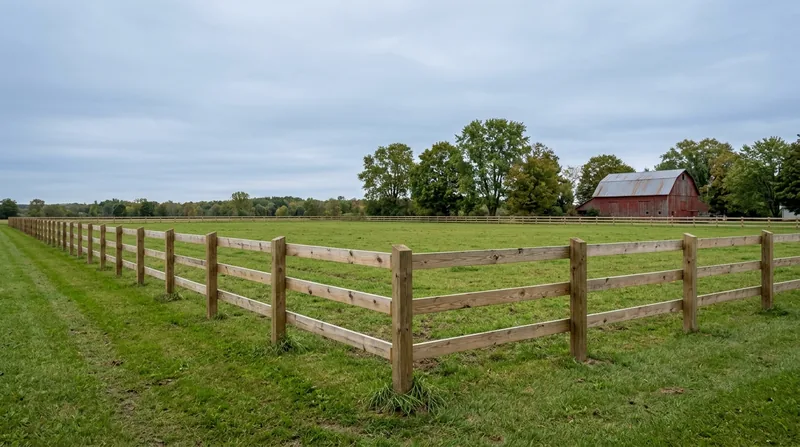




Rochester sits on the Genesee River where the lake plain rolls east into drumlin hills, and that ground decides how a farm fence gets built. Acreage out toward Victor, Fairport and the Ontario County line runs over dense glacial clay and silt that holds water in spring and heaves posts through the freeze-thaw cycle. A straight quarter-mile line of split rail or no-climb horse fence only stays straight when the corners are braced and the posts are set below frost. We handle farm fence installation in Rochester for landowners who need a line that holds livestock, keeps horses off the road, and survives lake-effect snow and plowed banks leaning on it every February.
Our crews run ranch rail, field wire, pipe and no-climb mesh across Monroe, Wayne, Ontario and Livingston counties. We work from your existing survey and set on the line you identify. Same crew start to finish, and we tell you when a repair is the smarter spend than a rebuild.
If you are fencing a smaller residential lot instead, start with our wood and privacy fence installation page.
Why Farm and Ranch Fencing Fails Faster Here Than Most Landowners Expect
The dominant failure on Rochester acreage is not livestock pressure and it is not wind. It is moisture at the ground line. Wet springs sit in that heavy clay, treated pine posts take water at the soil line, and the wood rots from the inside out while the top of the post still looks sound. Add deep frost lifting posts a fraction of an inch a year and you get lines that lean and sag long before the rails give out.
- Posts set too shallow heave out of the clay through repeated freeze-thaw and lose their line.
- Corners without proper bracing pull inward under tension from wire or mesh.
- Plowed snow banks off long driveways lean panels and push posts off plumb.
- Field wire rusts at the bottom where it meets wet ground, not at the top.
Every one of those is preventable at install time with deeper holes, proper corner bracing and concrete-set posts on the load-bearing points.
Key info: A 40-acre horse property outside Victor lost three corner posts in one season because the original installer tamped them into clay instead of setting them in concrete. We reset those corners with cross-bracing and the line has held through two winters since.
Fence height, setback and corner-visibility rules are set by the local building department and vary across Greater Rochester, so confirm the specifics for your town before the first hole is dug. New York State's official site is a good place to start for municipal links: ny.gov.
How We Build a Farm Fence Line Across Rochester Acreage
Long runs are a different job from a backyard privacy fence. We walk the line with you, call in the 811 utility locate before any digging (required by law in New York), and set post spacing to the material: wider on split rail and field wire, tighter on no-climb horse mesh where hoof pressure is real. Then we build the corners and ends first, because that is where a fence line actually holds or fails.
- We walk the fence line with you and mark gates, corners and any wet ground to avoid.
- We call 811 for utility locates before the first post hole is dug.
- We set corner and end posts deep and brace them, then run the intermediate posts to string line.
- We stretch wire or mesh with a stretcher bar and tension bands, not by hand tension alone.
- We hang gates sized for your trailer, tractor or equipment and check the swing.
Racked versus stepped installation matters on the drumlin slopes east of the city, and we choose per run rather than forcing one method across the whole property.
Key info: A Brockport property on the canal corridor needed a 900-foot line with two equipment gates. We set the corners in concrete, stepped the rails down the grade, and sized the gates so a stock trailer clears without backing twice. See how we handle gate installation and repair for the hardware side.
Farm Fence Methods We Install and What Each One Is Good For
There is no single right fence for acreage. The material follows the animal, the budget and how much snow the line will take. Here is how the main options compare on Rochester ground.
| Approach | Description | Best for |
|---|---|---|
| Split rail | Two or three rails on wood posts, cedar or treated pine, with concrete-set corners. | Property lines, pasture edges and a traditional look along the road. |
| No-climb horse fence | Woven wire mesh with small openings, tensioned between braced posts, often topped with a rail. | Horses, because hooves cannot catch in the tight mesh. |
| Pipe fence | Welded steel pipe rails on set posts, built for heavy contact and long service. | Working pens, cattle and high-traffic gate areas. |
| Barbed wire | Multiple strands on braced wood or steel posts, tensioned with a stretcher. | Cattle and large open pasture at the lowest cost per foot. |
| Field wire with wood posts | Woven field wire stapled to treated line posts, economical over long runs. | General boundary and keeping animals out of crops. |
We size gates for the equipment you actually own, and we will say plainly when a cheaper material will do the job.
Farm & Ranch Fencing Cost in Rochester: What to Expect
Farm fencing starts around $12 per linear foot and climbs from there. That figure covers a basic wood-post line with field wire or split rail on open, flat ground. Long runs bring the per-foot number down; tight corners, wet ground, and gates sized for equipment bring it up.
- Material: pipe and no-climb mesh cost more than split rail or field wire per foot.
- Post spacing and bracing: more concrete-set corners mean more labor and more concrete.
- Access: a line you can drive to goes faster than one you carry posts to by hand.
- Terrain: drumlin slopes need stepped or racked installation, which takes more time.
- Gates: each gate adds hardware, posts and a frame, and trailer-width gates cost more.
Get two or three written estimates on the same scope, and make sure each one states post spacing, bracing and gate sizes so you are comparing like for like. Our fuller breakdown lives on the pricing page.
Choosing a Fence Contractor Near Rochester: What to Check Before You Sign
Anyone with a truck can quote a fence line. What separates a crew that will still answer the phone in three years is paperwork, references and how they talk about the ground you are building on. Ask for a certificate of insurance and confirm workers' compensation cover before work starts.
Fence licensing here is set locally rather than by a single statewide fence license, and projects above certain dollar thresholds require a licensed general contractor, so ask your town building department what applies to your job. Fence height and setback rules vary by municipality, and HOA architectural standards often govern material and color in master-planned communities. Call two past customers with acreage similar to yours, and get every estimate in writing with post spacing and bracing spelled out.
Reach us through the contact page to set up a walk of your line.
Farm & Ranch Fencing Near Me: Matching the Fence to the Animal
The best fence for horses is no-climb mesh with a top rail, set on braced posts. Horses spook, run the line and paw at fences, and a hoof that goes through a large-opening wire or between rail gaps is a vet bill. Tight woven mesh with no sharp edges at hoof height is the standard for a reason.
Cattle tolerate barbed wire and pipe; sheep and goats need woven wire tight enough at the bottom to stop them pushing under. On the residential edge of Webster, Penfield and Pittsford, a landowner with two horses on five acres often gets a better result from a no-climb line with a wood top rail than from a full pipe fence. We will tell you which one your ground and animals actually call for.
Key info: On a small horse setup in Penfield, tight no-climb mesh with a cedar top rail cost less than pipe and gave the owner the look they wanted from the road. The mesh does the containing; the rail does the finish.
Whatever the animal, the corners and gates carry the load, so that is where the money belongs.
When to Repair and When to Replace a Farm Fence Line
Most failing farm lines are failing at the posts, not the wire. If the rails and mesh are sound and the posts are leaning or rotted at the ground line, resetting and replacing posts is the cheaper spend and the line comes back to true. If the wire is rusted through at the bottom and half the posts are gone, replacement is the better money.
We propose repair first whenever the fence justifies it. Our fence post repair and replacement page covers the reset work, and storm damage fence repair covers lines pushed over by wind off Lake Ontario or snow load.
One walk of the line usually tells us which way it should go, and we will say so straight.
Farm & Ranch Fencing in Rochester: Pricing Guide
| Service | Price | Details |
|---|---|---|
| Split rail or field wire line | Starting at $12/ft | Wood posts, braced corners and one wire or rail run on open, flat ground |
| No-climb horse fence | Starting at $16/ft | Tight woven mesh, tensioned between braced posts, often with a top rail |
| Pipe or heavy-duty fence | Starting at $28/ft | Welded steel rails and set posts for cattle, pens and high-traffic gate areas |
| Equipment or trailer gate | Starting at $450 each | Frame, hardware and set posts, sized to your trailer or tractor width |
| Complex or large acreage job | On estimate | Long runs, wet ground, slopes and multiple gates need an on-site walk first |
| Estimate | Free | Response within 24h at (585) 514-4609, no obligation to book |
Indicative pricing, the exact cost depends on square footage, finish, and site access. Free personalized estimate within 24h at (585) 514-4609.


